What Hard Water Does to an Industrial Boiler
How scale forms in boilers and cooling systems, what it costs in fuel, and how an industrial water softener differs from RO for hardness removal.
By Nishu Enterprises engineering team
Published · 5 min read
Hardness is dissolved calcium and magnesium. In a boiler, cooling tower or heat exchanger, those minerals come out of solution as the water heats and deposit on the hottest surfaces as scale. The damage is gradual, which is exactly why it is usually caught late.
Part of our buyer's guides. See water softening plants →
Scale is a fuel problem before it is a failure
Scale is a poor conductor of heat. A deposit on a boiler tube forces you to burn more fuel to transfer the same heat into the water, and that penalty compounds as the layer thickens. Long before anything fails, you are paying for it every day in gas or oil.
It rarely stops there. Scale narrows tubes and restricts flow, it causes local overheating where deposits are thickest, and it shortens the life of pumps, valves and heat exchangers throughout the circuit. In severe cases, overheating under a scale layer becomes a tube failure and an unplanned shutdown.
The symptoms to watch for: fuel consumption creeping up at constant output, longer heat-up times, and scale visible on inspection of tubes or the sight glass.
How a softener works
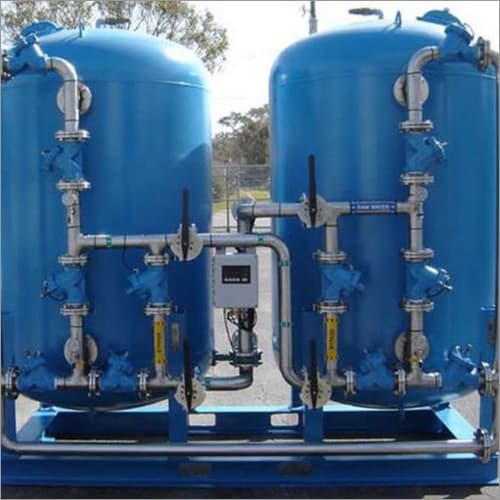
A water softener passes the feed through a bed of ion exchange resin that holds sodium ions. As hard water flows through, calcium and magnesium are taken up by the resin and sodium is released in their place. The water leaving the vessel carries no hardness, so there is nothing to deposit as scale.
The resin eventually saturates and is regenerated with a brine solution, which strips the accumulated hardness and recharges the bed with sodium. Regeneration can be manual or automatic on a timer or a volume meter. For anything running continuously, automatic regeneration is worth the difference.
Softener or RO?
They solve different problems and are often confused. A softener removes hardness only — it leaves total dissolved solids essentially unchanged. RO reduces dissolved solids across the board, hardness included.
| If the problem is | Use |
|---|---|
| Scale in boilers, cooling towers, heat exchangers | Water softener |
| High TDS in the supply | RO plant |
| High-pressure boiler feed needing very low conductivity | DM plant, often after RO |
| Hard water feeding an RO plant | Softener ahead of the RO, protecting the membranes |
That last row matters. Hardness fouls RO membranes, so a softener is frequently installed as pre-treatment rather than as an alternative. The two are complementary far more often than they are competing.
Sizing one correctly
Softener capacity depends on your feed hardness, daily volume, and how often you are willing to regenerate. A test report giving hardness in ppm as calcium carbonate, together with daily consumption and peak flow rate, is enough for a manufacturer to size a vessel and resin volume properly. Undersized softeners regenerate constantly and consume salt; oversized ones cost more than they need to.
Next step
Need this specified for your site?
Send us your water analysis and daily requirement and we will size the plant before quoting.