Water Softener for a Housing Society: Sizing, Salt Cost and What to Ask
How a housing society should size a central water softener: daily water use, hardness load, resin and salt, where to install it and what to ask suppliers.
By Nishu Enterprises engineering team
Published · 7 min read
White scale on every tap, geysers failing within a year and shower glass that never looks clean: in a society running on borewell or tanker water, the cause is usually hardness. A central softener treats the whole building at once. Sizing it properly decides whether it works and what it costs to run.
Part of our buyer's guides. Water softeners for housing societies →
What a softener does, and what it does not
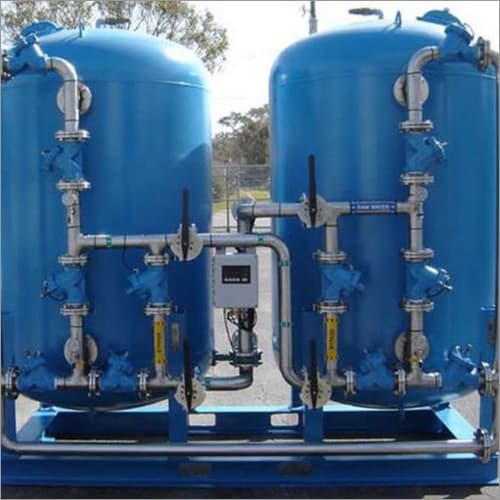
A softener passes water through a bed of ion-exchange resin that swaps calcium and magnesium (the hardness) for sodium. It stops scale. It does not lower total dissolved solids, remove bacteria or improve salty taste. If the water is high in TDS as well as hard, drinking water needs an RO plant, and the softener protects the rest of the building.
Step 1: daily water use
Start from the number of residents. India's urban planning norm (CPHEEO) for homes with sewerage is 135 litres per person per day. Your society's actual use may differ, and the society's pump running hours or tanker bills are the best check.
| Example society | Value |
|---|---|
| Flats | 120 |
| Residents per flat (assumed) | 4 |
| Water per person per day | 135 litres |
| Daily water use | 120 × 4 × 135 = 64,800 litres, about 65 m³ |
Step 2: the hardness load
Get a water test that reports total hardness in mg/L (ppm) as calcium carbonate. Multiply it by the daily volume to find how much hardness the softener must remove each day.
| Example | Value |
|---|---|
| Total hardness | 400 mg/L as CaCO3 (assumed) |
| Daily hardness load | 65 m³ × 400 g/m³ = 26,000 g, about 26 kg |
Step 3: resin and salt
Resin volume and salt use follow from the hardness load and how often the softener regenerates. The figures below are typical design values used for illustration only; your supplier should show the calculation for your water with their resin and salt dose.
| Example | Value |
|---|---|
| Resin operating capacity (typical) | About 50 g of hardness per litre of resin |
| Resin for one day between regenerations | 26,000 ÷ 50 = about 520 litres |
| Salt dose (typical) | About 150 g per litre of resin per regeneration |
| Salt per day | 520 × 150 g = about 78 kg |
| Salt per month | About 2.3 tonnes |
Salt is the running cost that surprises committees. Multiply the salt per month by the local price of softener salt before approving a quote, and ask the supplier to state the salt dose they have designed for.
Softening only the lines that need it can cut that cost sharply. Many societies soften the supply to bathrooms and geysers and keep drinking water on a separate line or an RO plant.
Where to install it
- Usually on the transfer line between the underground sump and the overhead tanks, where the transfer pump provides the pressure.
- With space for the vessels, a brine tank and a delivery of salt bags, plus a drain for regeneration water.
- With a bypass valve, so water keeps flowing during service.
- With a sampling point after the softener, so hardness can be checked with a simple test kit.
Automatic or manual regeneration?
Manual regeneration depends on someone remembering to do it. For a society, an automatic valve that regenerates on a volume meter is the safer choice: it regenerates when the resin is actually exhausted, which saves salt compared with a fixed timer.
What about salt-free conditioners?
Magnetic, electronic and other salt-free devices do not remove hardness. Some aim to change how scale forms, and results vary. If you are offered one, ask for independent test data on water like yours and for a written performance guarantee.
Questions for suppliers
- What daily volume and hardness did you design for, and on what water test?
- How much resin, what salt dose, and how much salt a month will we use?
- How is regeneration triggered: volume, timer or manual?
- Where will regeneration water drain, and how much is it per cycle?
- What does the AMC cover: valve servicing, resin checks, salt refilling?
- What outlet hardness do you guarantee, and how will we check it?
A committee that asks these questions gets comparable quotes and a softener that is neither undersized and constantly regenerating, nor oversized and expensive to buy.
Next step
Need this specified for your site?
Send us your water analysis and daily requirement and we will size the plant before quoting.